Click here to sign up for daily motivational text messages!
...
Click here to sign up for daily motivational text messages! ...
Mettle maker #489: Optimism vs. Cynicism
God save us from cynics, naysayers, Negative Nancies, and Gloomy Guses These are the folks who are always telling us that there’s no use trying, that whatever it is will never work, that the juice ain’t worth the squeeze, and that the risk ain’t worth the reward.
Aargh.
In my experience, these are the same people who claim to be on the side of practicality and common sense. Now, I’m all for practicality and common sense. But these folks push practicality to such an extreme that they drain all of the wonder, magic, and possibility from life.
Here’s what they don’t get:
Only he who attempts the absurd is capable of achieving the impossible. (Miguel de Unamuno)
For more on the incredible power of positivity and possibility, read today’s homily below, or watch the video.
Set goals in your martial arts training. Train and write in your journal every day. Start small and go slow. Don’t overtrain. Listen to your body and give yourself time. Bit by bit, inch by inch, you can climb a mountain. How did Michel Lotito eat an entire airplane? By cutting it into very small chunks.
Fine. Maybe you won’t get there.
But you might. You won’t know until you try. Not try with great intensity for a short period of time and ultimately give up, but really try. Try with everything you’ve got. Remember, “trying hard” probably doesn’t mean working with hyperintensity for a short period of time. More likely, “trying hard” means working consistently for a very, very long time.
Want to train and fight like an old-timer? Click here to sign up today for our distance learning program! In other news, the new t-shirts are in. If you want to make a donation to the charity, we can definitely get you one! Just click here.


Holy Eucharist is LIVE on YouTube every Sunday at 10 am EASTERn. Click HERE to watch live. To view and print a copy of the program for holy Eucharist, CLICK HERE.
Homily for the Fourth Sunday of Advent, 12/21/25 – Father Mitch
Readings: Isaiah 7:10-14, Psalm 24:1-2, 3-4, 5-6, Romans 1:1-7, Matthew 1:18-24
Matthew 1:18-24 World English Bible
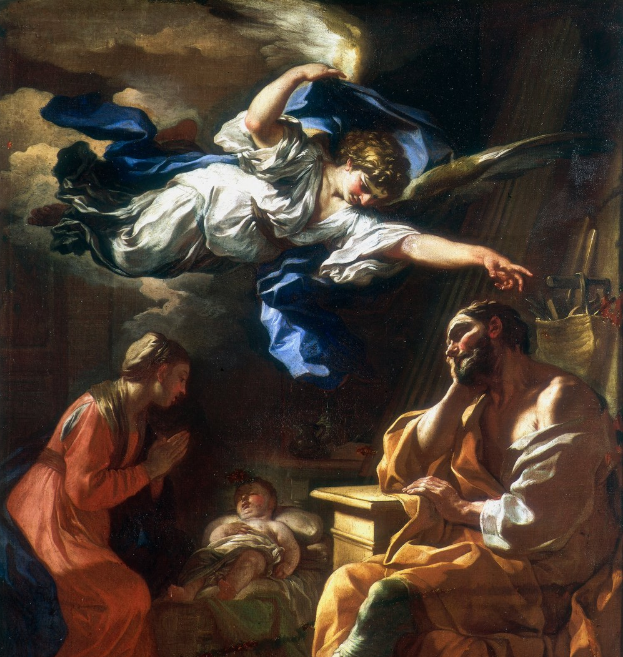
Now the birth of Jesus Christ was like this: After his mother, Mary, was engaged to Joseph, before they came together, she was found pregnant by the Holy Spirit. 19 Joseph, her husband, being a righteous man, and not willing to make her a public example, intended to put her away secretly. 20 But when he thought about these things, behold,† an angel of the Lord appeared to him in a dream, saying, “Joseph, son of David, don’t be afraid to take to yourself Mary as your wife, for that which is conceived in her is of the Holy Spirit. 21 She shall give birth to a son. You shall name him Jesus,‡ for it is he who shall save his people from their sins.”
22 Now all this has happened that it might be fulfilled which was spoken by the Lord through the prophet, saying,
23 “Behold, the virgin shall be with child,
and shall give birth to a son.
They shall call his name Immanuel,”
which is, being interpreted, “God with us.”*
24 Joseph arose from his sleep, and did as the angel of the Lord commanded him, and took his wife to himself; 25 and didn’t know her sexually until she had given birth to her firstborn son. He named him Jesus.
There are, broadly speaking, two attitudes: rejecting and accepting. We can either view the events of life as obstacles or opportunities. We can be cynical – seeing the worst in people and situations – or we can be optimistic, seeing the potential good in whatever comes our way.
We can see these attitudes at play in our readings today. In Isaiah 7, God tells King Ahaz to ask for a sign. But Ahaz makes an excuse. He says, "I will not ask! I will not tempt the LORD!" Why? Perhaps he doesn’t see how asking for a sign benefits him. If he receives a sign, he’ll have to act on it. If there is an opportunity to see or perhaps perform a great act in cooperation with God’s direction, that might be difficult or costly. Maybe he’d have to give up his fortune or even his life. But God gives him a sign anyway: “the virgin shall conceive, and bear a son, and shall name him Emmanuel.”
Certainly we can choose, like Ahaz, to avoid asking God to show us the good in every situation. We can decide not to ask him how we can serve his purposes. We can decide to be cynical and negative. We can either embrace God’s plan, or we can run from it – but God is not going to change his plans to suit us. The only question is whether not we are going to participate in his plan or not.
St. Paul, in his letter to the Romans from which we read today, gives the good news to the people of Rome. It varies in the finer points from the way God gave it to Ahaz, but the implications overlap. First St. Paul lays out the facts in a manner that would eventually become concrete in the Apostle’s Creed. Then he says that everyone is called to belong to Jesus Christ. By the grace of God, many heard this news and came to believe. In just a few hundred years, even the emperor of Rome became a believer. There must have been many people who heard St. Paul’s words with cynical, rejecting ears. But their failure to participate in God’s plan did not change the outcome even one jot.
What a miracle it is, brothers and sisters that Joseph, Mary’s betrothed, chose to be receptive to the revelations of God. It would’ve been very easy for him to disregard the message of God that came to him in his dream. In his culture, the scandal of marrying a girl carrying another man’s bastard child would’ve risked lifelong shame for the couple. They might’ve been shunned by society, resulting in social and financial ruin. But no – St. Joseph decided to cooperate with God. He accepted what the angel told him in the dream. He believed the miraculous revelation, accepted and cooperated with God’s plan, and went forward in trust and optimism.
We have a choice. We can see, as the saying goes, the glass as half empty or half full. We can see our lives as never-ending, pointless struggles ending in death; or we can see life as a gift and a miracle that merely transitions from this life to eternal life in the presence of God. We can, like St. Joseph, choose to see this life, and God’s plan for it, as a miraculous revelation and face it with a heart filled with love, joy, and wonder.
---------------------------------------------------------------------------
† 1:20 “Behold”, from “ἰδοὺ”, means look at, take notice, observe, see, or gaze at. It is often used as an interjection.
‡ 1:21 “Jesus” means “Salvation”.
* 1:23 Isaiah 7:14