Click here to sign up for daily motivational text messages!
...
Click here to sign up for daily motivational text messages! ...
Mettle maker #490: Facta Non Verba
There’s great utility in learning Latin. It gives you insight into the way people used to write and think before the modern era, and a deeper understanding of what our words mean. Take for example the Latin motto, “Facta Non Verba” which translates to “Deeds Not Words.” Let that sink in for a second. Facts are not propositions.
Facts are things you do.
Meditate on the concept that what makes the statement “I am a martial artist” true is the fact that you do martial arts. A fact is not a falsifiable set of circumstances, a defensible argument, or a cohesive proposition. A fact is a deed.
So let’s get off our duffs and start establishing some facts, shall we? And speaking of actions not words, read today’s homily below and learn what you can from the example of St. Joseph.
Heads up: Coming next week to the YouTube channel: a set of “solo sparring drills” inspired by the brilliant and unusual training methods of the incomparable John Brookfield. I worked just three rounds of these new drills yesterday, and today I feel like I actually sparred for three rounds (minus the bruises of course). You’re going to love ‘em. So subscribe to the channel and stay tuned!
Want to train and fight like an old-timer? Click here to sign up today for our distance learning program! In other news, the new t-shirts are in. If you want to make a donation to the charity, we can definitely get you one! Just click here.


Holy Eucharist is LIVE on YouTube every Sunday at 10 am EASTERn. Click HERE to watch live. To view and print a copy of the program for holy Eucharist, CLICK HERE.
Note: if you missed Christmas service, click here to view the video.
Homily for the Feast of the Holy Family, Sunday 12/28/25 – Father Mitch
Readings: Sirach 3:2-6, 12-14, Psalm 128:1-2, 3, 4-5., Colossians 3:12-21, Mt 2:13-15, 19-23
Colossians 3:12-21 World English Bible
Put on therefore, as God’s chosen ones, holy and beloved, a heart of compassion, kindness, lowliness, humility, and perseverance; 13 bearing with one another, and forgiving each other, if any man has a complaint against any; even as Christ forgave you, so you also do.
14 Above all these things, walk in love, which is the bond of perfection. 15 And let the peace of God rule in your hearts, to which also you were called in one body, and be thankful. 16 Let the word of Christ dwell in you richly; in all wisdom teaching and admonishing one another with psalms, hymns, and spiritual songs, singing with grace in your heart to the Lord.
17 Whatever you do, in word or in deed, do all in the name of the Lord Jesus, giving thanks to God the Father through him.
18 Wives, be in subjection to your husbands, as is fitting in the Lord.
19 Husbands, love your wives, and don’t be bitter against them.
20 Children, obey your parents in all things, for this pleases the Lord.
21 Fathers, don’t provoke your children, so that they won’t be discouraged.
Matthew 2:13-15, 19-23 World English Bible
Now when they had departed, behold, an angel of the Lord appeared to Joseph in a dream, saying, “Arise and take the young child and his mother, and flee into Egypt, and stay there until I tell you, for Herod will seek the young child to destroy him.”
14 He arose and took the young child and his mother by night and departed into Egypt, 15 and was there until the death of Herod, that it might be fulfilled which was spoken by the Lord through the prophet, saying, “Out of Egypt I called my son.”*
19 But when Herod was dead, behold, an angel of the Lord appeared in a dream to Joseph in Egypt, saying, 20 “Arise and take the young child and his mother, and go into the land of Israel, for those who sought the young child’s life are dead.”
21 He arose and took the young child and his mother, and came into the land of Israel. 22 But when he heard that Archelaus was reigning over Judea in the place of his father, Herod, he was afraid to go there. Being warned in a dream, he withdrew into the region of Galilee, 23 and came and lived in a city called Nazareth; that it might be fulfilled which was spoken through the prophets that he will be called a Nazarene.
Today’s readings contain a powerful message for us all, one that we can carry with us all the days of our life. What a shame it is that so many people misunderstand them and therefore avoid them, even shying away from them. I am speaking of the contentious Colossians 3:18 “Wives, be in subjection to your husbands, as is fitting in the Lord.” Is this line at odds with modern sensibilities and attitudes? Yes it is – but not in the manner assumed by most. The footnote to this passage in the Ignatius Catholic Study Bible, 2nd Edition says, “Paul gives pastoral instruction on family life. He is challenging every household to be transformed with the ‘peace of Christ’ (3:15). The apostle’s vision for domestic life stands in stark contrast to the godlessness of the pagan society, especially the tyranny of husbands and fathers.”
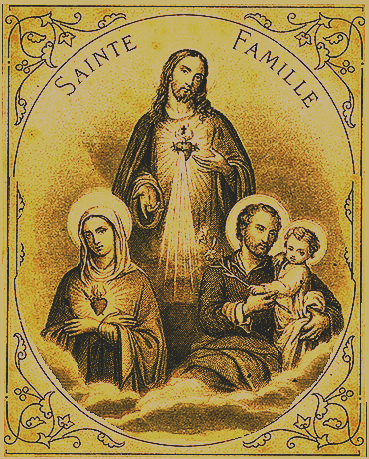
The Holy Family
Paul is instructing the faithful to put in place a mutual and voluntary family relationship that stands athwart the chauvinistic arrangements of the pagan past and the disordered situations so often seen in the world today. In Eph. 5:22-25, Paul adds, “Wives, be subject to your own husbands, as to the Lord. 23 For the husband is the head of the wife, as Christ also is the head of the assembly, being himself the savior of the body. 24 But as the assembly is subject to Christ, so let the wives also be to their own husbands in everything. 25 Husbands, love your wives, even as Christ also loved the assembly and gave himself up for her.”
A Christian husband and father is expected to love his wife and family unconditionally and self-sacrificially, embodying as much as possible, Christ’s love for us. And the wife should not be forced into submission but rather should voluntarily and naturally align with her husband’s selfless leadership. By the light of this interpretation, and in light of today’s gospel reading, what can we say about St. Joseph?
Here is a man about whom we know virtually nil. The New Testament tells us nothing about his life before or after the Nativity story. He lived, worked, and died in virtual anonymity, completely overshadowed by his stainless wife Mary who gave birth to the Son of God. By this we know that he was humble beyond compare. We also know that he was blessed by God with a vision and given the faith to trust it and act accordingly. And we know that he was a strong, courageous, and hardworking man, because he led his family on a long and arduous journey through rough and lawless lands, bringing them safely to Nazareth where he labored and maintained a livelihood for them.
Who would not voluntarily follow such a man, such a leader, as this? And what a world might it be like if all men walked with God as Joseph did?
--------------------------------------------------------
* 2:15 Hosea 11:1