News and Updates:
Member referral program. Distance learners who get a friend to sign will earn a feat in the program — and you’ll both get a free shirt. Just tell them to put your name in the “referred by” slot on the application. Members in the RVA club, bring a friend and the same goes for you!
METTLE MAKER #506: Habitude 5 of the Founding Fathers
Join us in cultivating the 7 Habitudes of the Founding Fathers! Step into their mindset and embrace their ideals. Embody the view that personal self-government is a prerequisite for political self-government. It’s the the perfect way to celebrate the 250th Anniversary of the Signing of the Declaration of Independence and honor the great men who made it a reality. Post your experiences with this exercise using the hashtag #7H250.
Habitude 5: Swing the Bells
In a letter to his son in 1772, Ben Franklin wrote,
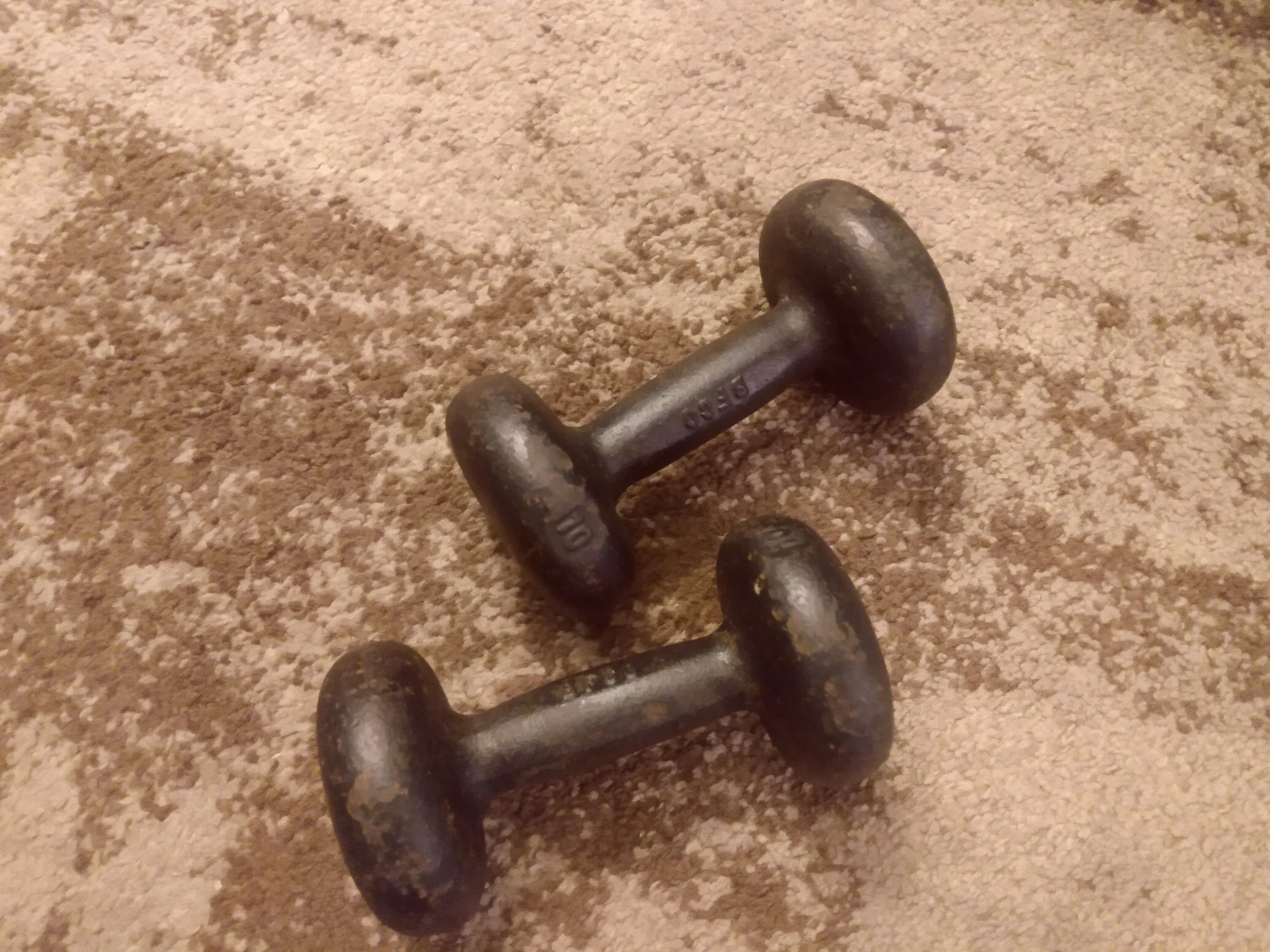
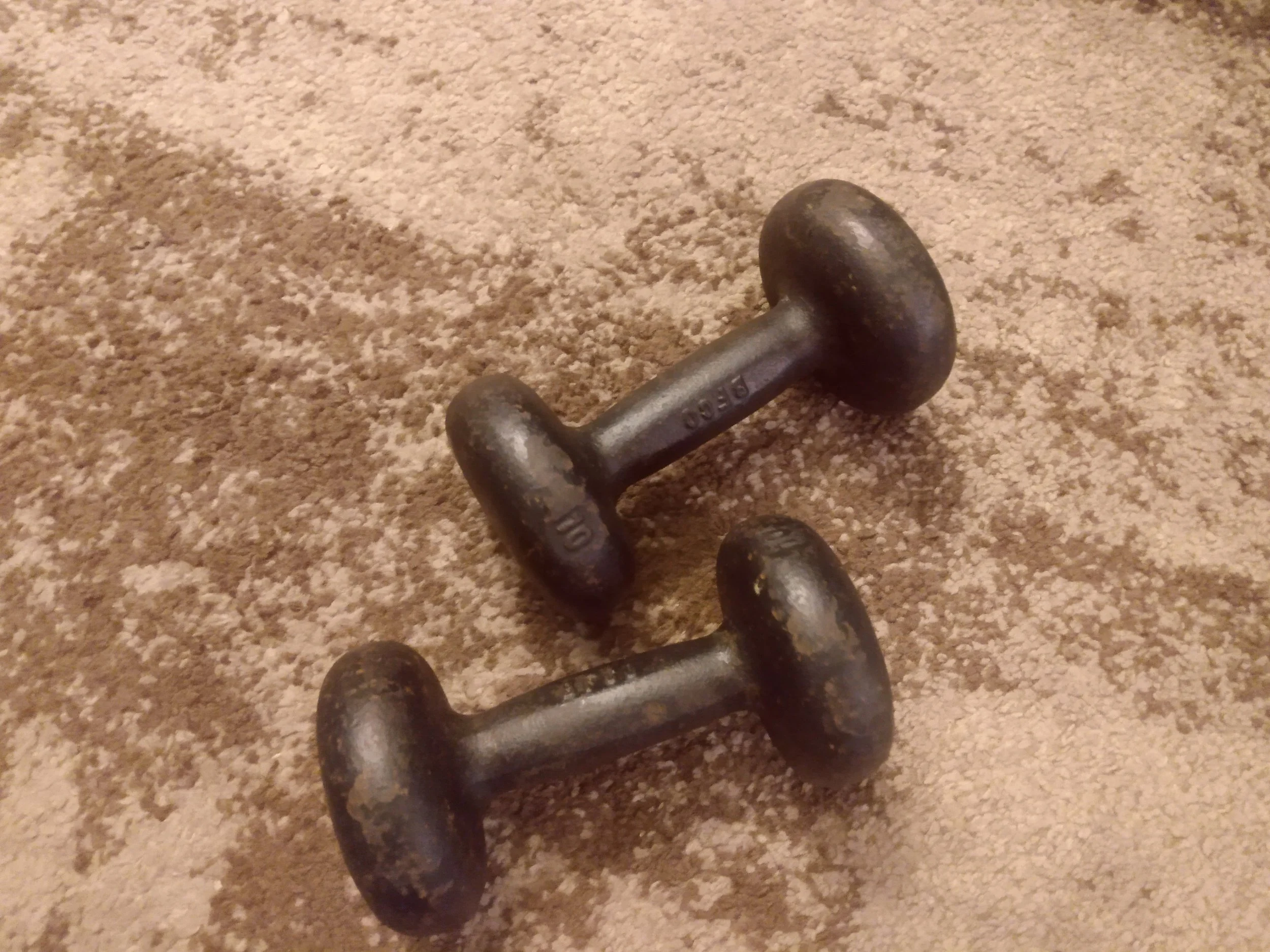
Thanks to Heritage Arts donor James for sharing this photo of his antique dumbbells.
“I cannot walk an hour briskly, without glowing from head to foot by the quickened circulation, I have been ready to say (using round numbers without regard to exactness, but merely to make a great difference) that there is more exercise in one mile’s riding on horseback, than in five in a coach; and more in one mile’s walking on foot, than in five on horseback; to which I may add that there is more in walking one mile up and down stairs, than in five on a level floor. The two latter exercises may be had within doors, when the weather discourages going abroad; and the last may be had when one is pinched for time, as containing a great quantity of exercise in a handful of minutes. The dumb-bell is another exercise of the latter compendious kind. By the use of it I have in forty swings quickened my pulse from sixty to one hundred beats in a minute, counted by a second watch; and I suppose the warmth generally increases with quickness of pulse.”
Nowadays kettlebells are all the rage, and the most popular exercise in which they are employed is the swing. While some claim an unbroken historical lineage back to the Ancient Greece or China, they most probably originated as scale weights in 18th century Russia. Older by a hundred years or so is the humble dumbbell. Unlike kettlebells, which were and are rather heavy, the dumbbells used by our founding fathers were comparatively light.
It is a common misconception that old-time folks didn’t need to do fitness because they got what they needed from pre-modern manual labor – farm chores, building railroads, unloading ships and wagons, and so on. Poppycock. The old-timers developed their training methods because they did so much manual labor that they had to develop ways to prevent, avoid, counteract, and heal repetitive use injuries.
Repetitive use injuries were even more common back then than they are now. Nowadays, despite having more leisure time, better drugs, protein powder, and all kinds of fancy equipment, twenty-first century weekend warriors practicing high-rep, heavy weightlifting suffer serious repetitive use injuries, providing plenty of business for Orthopedic surgeons and physical therapists. Old-timers were live without a net. One slip – one injury without modern surgical interventions, medications, therapies, conveniences, and without backstops like health insurance and workmen’s compensation – and they couldn’t work to feed themselves or their families. They had be smarter and more cautious by far than us modern folks.
This is why old-time dumbbells were light, weighing between 2 and 5 lbs each (1 or 2 kilos), and were used in entirely different manner than they are today, and with startingly more variety. Reps per set could be comparatively high, from 20 up into the hundreds. Generally speaking, rather than being used to isolate specific muscles as they are today (biceps curl, triceps extension, etc.), the old-timers used them while executing complex, compound movements involving multiple muscles and muscle groups. In addition to being pressed and curled, they were swung and punched. Sometimes they were moved in a slow and controlled manner. Other times they were swung rather than lifted, and moved with “snap” and “vigor” until the user grew tired of a given movement.
We can’t be sure exactly what Benjamin Franklin’s swing looked like. The records just aren’t there. But based on what we do have, here are three likely variants.
Variant 1 (Fig. 3 below). Stand erect with heels together with feet in a “V” with dumbbells hanging pendant at the sides. Swing the dumbbells upward to the greatest extent comfortable, arching the back and looking upward. Then swing the bells down and behind the back, also to the farthest comfortable extent, keeping legs straight. Repeat until fatigued.
Variant 2. Stand erect with heels together with feet in a “V.” Bend the knees slightly and hinge at the waist as you swing the dumbbells back to the fullest comfortable extent; then thrust hips forward, straighten the back, and swing the bells up to their fullest comfortable extent, looking upward. Repeat until fatigued.
Variant 3 (Fig 7 below). Stand with the legs slightly more than shoulder width. Extend the arms vertically. Bend back as far as possible, then swing the bells down and as far between the legs as possible and up again, repeating until tired.
Just a few exercises can get boring over time. For more variety, here are six additional 19th century exercises you can layer on top of your Franklin Swings, or periodically swap out, to keep your dumbbell swinging practice fresh and fun. Why 19th century exercises rather than 18th? Because, after a hundred years of experimentation and practice, and with the improvements in printing technology, we have far more reliable historical sources to draw upon in order to tap into old-school wisdom.
Remember, as you experiment with these exercises, that some sources advised that movements should be fast and continuous, while others (especially military sources) advise performing exercises quickly but with a full stop at the end of each phase. Others mandate a fast contraction phase and a slow expansion phase.
Experiment and enjoy!
Additional Dumbbell Exercises
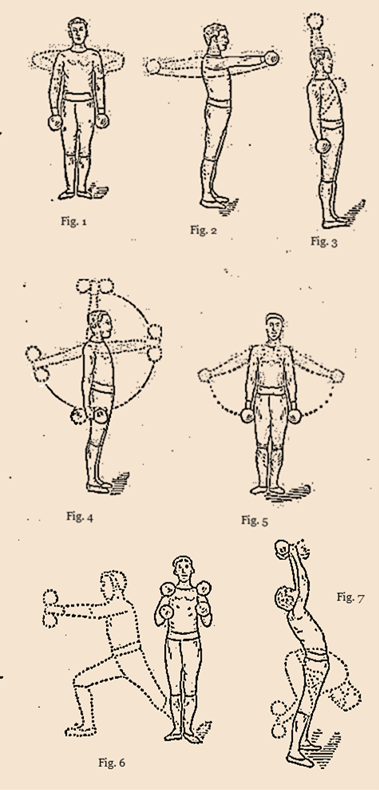
1. Side Row with Wrist Curl (Fig 1) Hold the bells at the side with the arms pendant. Draw the bells up to the armpits, turning the wrist as far in as possible. Repeat this and all other movements until fatigued. Keep shoulders down and back throughout.
2. Lateral circles (Fig 2): Hold the arms horizontally in front, pass them back on a line with the shoulders as far as possible, crossing the arms in returning.
3. Curl, Twist & Press (Fig 3): Curl the dumbbell bell from the pendant position with palm facing you until it’s on a line with the shoulders, then turn the palm out and extend the arm vertically pressing it upward. Reverse the movement, resuming the first position. Repeat.
4. Side Vertical Swing (Fig 4): Keep the arms straight and swing the bells over the head and as far back as possible, then reverse the direction and swing the arms down past the sides and up behind the back.
5. Lateral Raise (Fig 5): Hold the arms at the side but slightly forward such that, if you wanted to, you could touch them together in front of your groin if you wanted to. Un-shrug your shoulders and lift the bells up and to the side, keeping them in front of your body. Turn thumbs up slightly at the top of the arc. Do not go past approx. 60 degrees, and do not sling.
6. Chargers (Fig 6): Stand erect, holding the bells at the chest. Step out to the side as far as possible, at the same time punching the arms horizontally. Regain the first position and repeat the movement on the opposite side. Vary the movement by stepping to the front and rear.
7. Franklin Swings Variant 3 (Fig 7 below). Stand with the legs slightly more than shoulder width. Extend the arms vertically. Bend back as far as possible, then swing the bells down and as far between the legs as possible and up again, repeating until tired.
Want more American Rough ‘n’ Tumble goodness? Click here to sign up today for our distance learning program!
Sacred Reading for Sunday, 7/19/26
Click here to sign up for daily motivational text messages!
...
Click here to sign up for daily motivational text messages! ...

Lectio Divina is an ancient way to interact with the Bible. Its four elements are reading, meditation, contemplation, and prayer. CLICK HERE for the Sunday Lectio exercise. To watch daily mass, CLICK HERE. For daily gospel reflections in your email box, SIGN UP HERE.
Or even better, go to church. The old-timers did, and it’s their steps we’re following in, right? So put on a collared shirt and saddle up.
In other news, the new t-shirts are in. If you want to make a donation to the charity, we can definitely get you one! Just click here.


